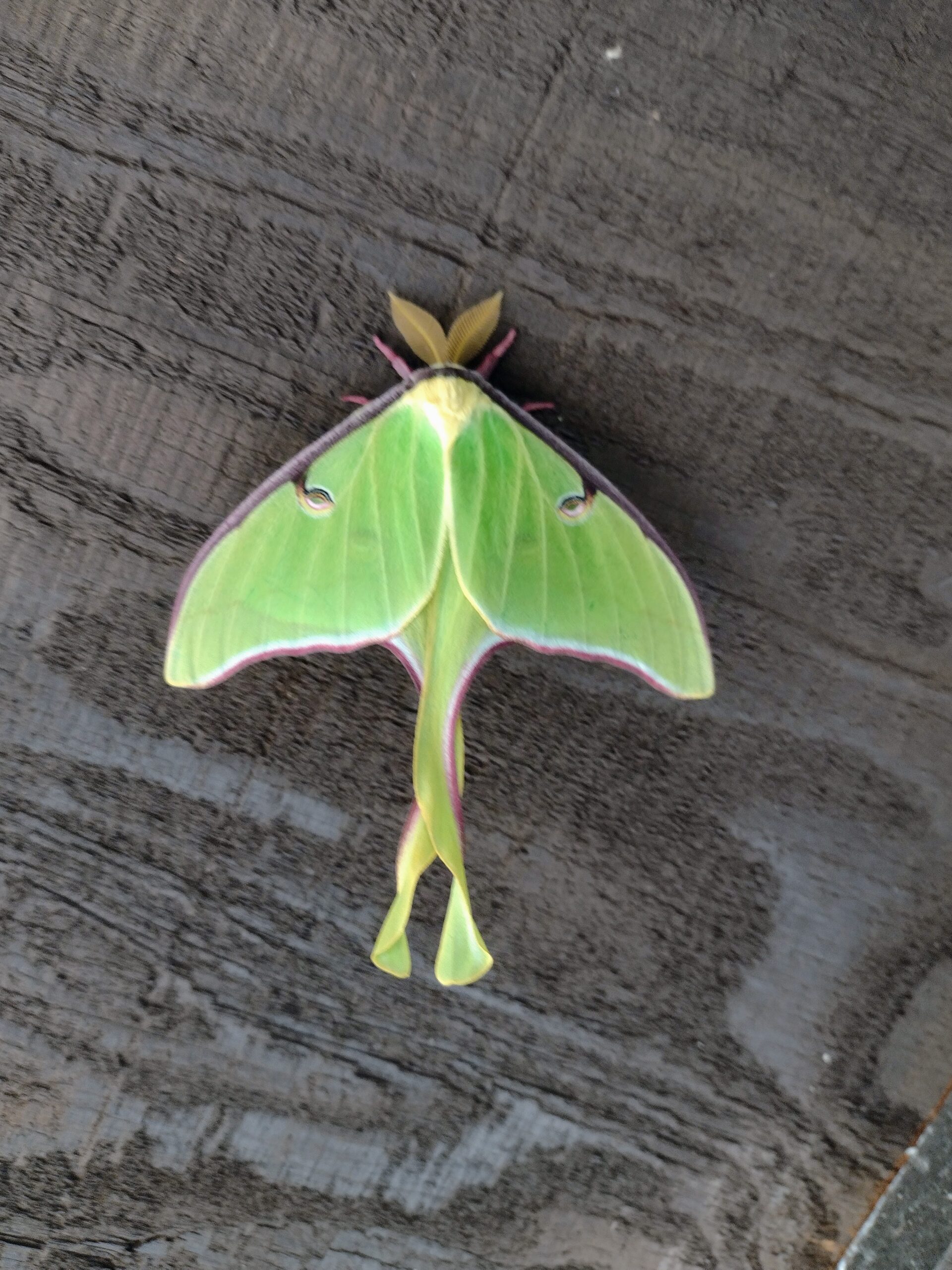
The first time I saw a luna moth, Max was letting it flutter around the room, retrieving it when it landed on a table leg, the arm of a couch. He’d caught it, somehow, in the Arkansas night and had brought it in to show me. I thought bugs that size only existed in the tropics, but there it was—huge and pale—its majesty defying what the word “moth” typically brings to mind. Several inches long, luna moths are light green, with small brown eyespots on paper-lantern wings. I was enchanted—with the moth itself, and with the man who’d caught it.
Years later, I caught a second glimpse. Max and I had graduated college, gone our separate ways, then reconnected. Now engaged, we were in the Adirondacks on a hiking trip. I nearly walked by, fooled by its camouflage, but Max, extraordinarily attuned to bugs and butterflies, spotted it resting against a tree. Its colors were muted, but it had the same giant wings, gentle eyes. Peering together at the moth, I was struck by its other-worldliness.
On our first date, he’d coaxed a blue butterfly onto his finger. Now, I tried to copy him, licking my finger and placing it near the moth’s head. “I don’t think it has a mouth,” he said. (How did he know these things?) He caught it up in his hands and let me study it. Nine years after that first luna meeting, several states, continents, and relationships later, here I was again with this man who befriended hoverflies and hummingbird moths and once casually bent over to pick a four-leaf-clover as we walked across a field. We had, a few months earlier, cancelled the wedding, and the relationship was hanging on by a few stitches, one of them our common love for nature. Perhaps the moth was a sign from beyond, though I couldn’t fathom what it meant.
Years later, I found myself once again in the Arkansas woods for a friend’s wedding. Grief knotted in my heart and stomach. I’d been avoiding weddings since the breakup, tucking out of sight anything that reminded me of the lingering grief. Trying to stay positive, wanting to enjoy my friends, I pushed down the feelings, but they weren’t listening; my stomach hurt and I was having trouble smiling.
After the reception, back at the cabin, my friends and I were sprawled around the living room unwinding. I still felt unsettled, holding a big, unspoken grief.
Something caught my eye outside the window, and I stood in disbelief. Fluttering in circles was a giant, pale-green insect, silky wings like a bride’s flowing gown—the third I’d seen in my thirty-five years. I stepped outside to watch her circular dance as she courted the light. She settled down on a rafter, and I stepped closer: fuzzy antennae, opulent wings, and two brown eyes in their giant green sockets.
The biblical story of Hagar came to mind. Fleeing what is now the West Bank, Hagar finds herself in the wilderness. Enslaved, abused, pregnant by her mistress’s husband, she is running for her Egyptian homeland. An angel appears to her—like Mary—and delivers God’s promise to bless her child and descendants. She is told they will be numberless—the same promise given Abraham. It is a promise to respond to her suffering and shape it into something unimaginably beautiful. A promise of redemption. Hagar then names God, “the One who sees me.” Hagar, in her way, was prophesying—like Isaiah—about Jesus, the One who sees us, who comes to us in our pain and need, who cares about the plight of a single, pregnant woman without a home.
My friend Karri stepped out to check on me. I told her about Max. She’d lost her mom that year, and we sat up talking and crying about the grief, the questions, the hurt, the moth keeping watch overhead.
Gazing at the luna moth, I saw an angel in the wilderness, pronouncing blessing on what had been broken. In the moth, I saw the One who sees us, seeing me.